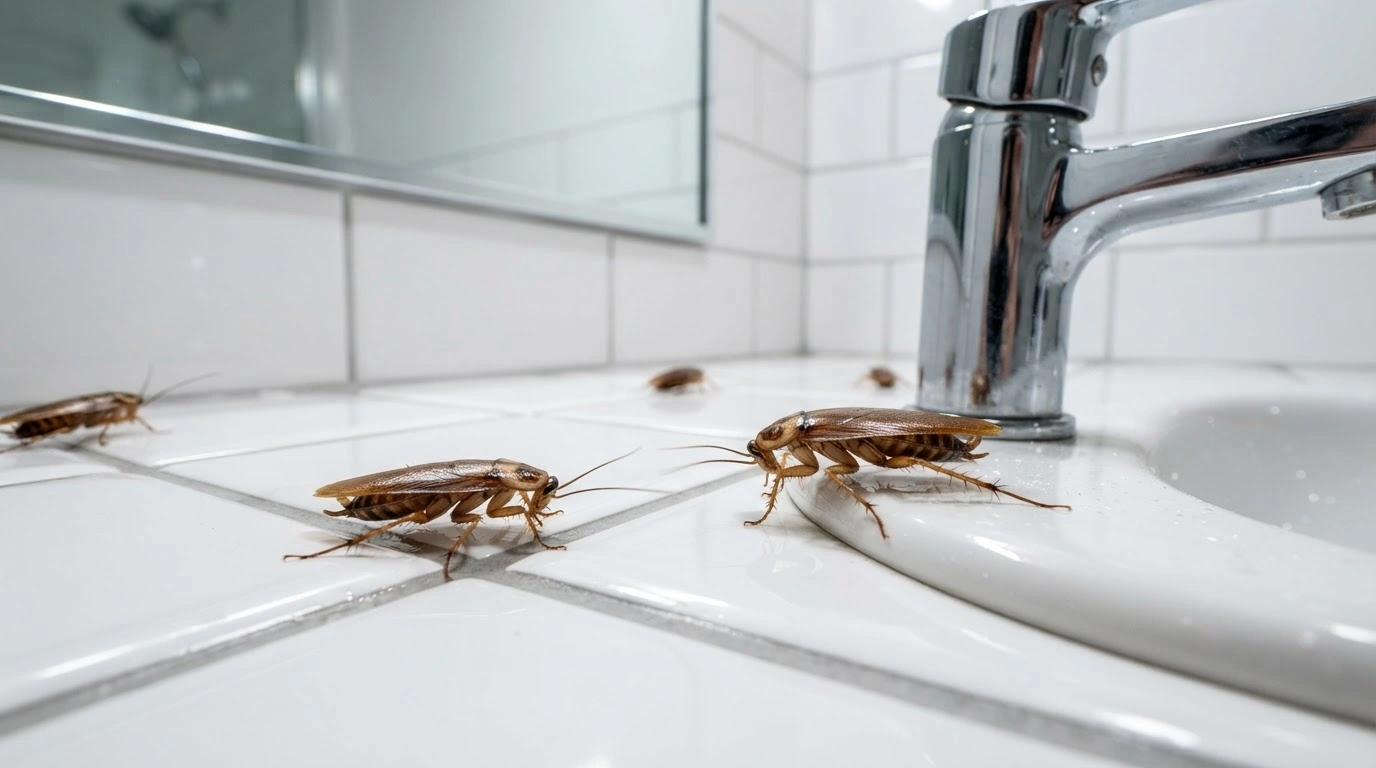
It usually happens at night. You flip on the bathroom light and something brown darts under the vanity, or you find one on its back in the tub the next morning. In a humid Southern house, the bathroom is often the first room where roaches show up and the last one they leave.
How clean you keep the room has little to do with it. Bathrooms offer three things roaches want: water, warmth and dark gaps behind fixtures. The plumbing that runs through walls and floors also gives them a road between the bathroom, the crawlspace, the attic and the yard.
What Draws Cockroaches to Florida Bathrooms in the First Place
Several species share Southern homes, and they behave differently. The large American and smokybrown cockroaches tend to live outdoors and wander in through drains, pipe gaps and soffits. German cockroaches are smaller and tan. They breed indoors, usually in kitchens and bathrooms.
The species decides the fix. A practical guide to cockroaches in bathroom Florida homes draws the useful line: a big roach climbing out of the shower drain points to an entry problem, while small ones clustered under the sink point to a colony living in the room.
The same corner keeps attracting them for a reason. According to this article, whose cockroach fact sheet was last reviewed in February 2025, roach droppings carry an aggregation pheromone that draws other roaches to the spot. Scrubbing those dark specks away with hot, soapy water makes the area less inviting.
The extension guide also covers the basics to know before you pick a treatment:
| Topic | What the extension guide reports |
| Most common roaches in and around homes | Florida woods roach, American, smokybrown, brown and German cockroaches |
| Where German cockroaches usually live | Kitchen and bathroom, though they can turn up anywhere in the house |
| Prevention and sanitation categories | Four: exclusion, plus removing water, food and hiding places |
| Bathroom crack-and-crevice treatment points | Cracks around pipes under sinks, around toilet bowls and along baseboards |
| Florida woods cockroach adult size | About 1¼ inches (31.75 mm) long |
Fixing Moisture, Leaks and Drains Before Anything Else
No spray will hold up in a wet room. Start under the sink with a flashlight and a dry paper towel. Wipe the trap, the supply lines and the shutoff valves, then check the towel for dampness. A slow drip at a compression fitting can keep a cabinet floor moist for weeks before anyone notices.
Next, the toilet base. A failing wax ring often leaves a faint stain or a soft spot in the flooring, and that wet subfloor is prime habitat. After every shower, run the exhaust fan for 20 to 30 minutes so the walls and grout dry out instead of sweating overnight.
Then the drains. Guest bathrooms and floor drains that rarely see water can lose the seal in their traps, leaving an open pipe straight to the sewer line. A quart of water poured down each unused drain once a week keeps that seal in place. A fitted drain cover blocks the larger roaches that climb up at night.
Baits, Growth Regulators and Crack Sprays Compared
With the water handled, most homeowners choose among three approaches. Each has tradeoffs.
Gel baits go in small dots inside cracks and behind fixtures. Roaches eat the bait, return to hiding and spread it to others, which suits baits to German cockroach colonies. The cost is patience. Results take one to two weeks, and baits fail if you spray a repellent cleaner over them or leave crumbs that compete for attention.
Insect growth regulators won't kill adults quickly. They interfere with development, so nymphs never reach breeding age. Alone they feel slow; paired with bait, they shut down the next generation. Against an American roach that wandered in from outside, they did little.
Crack-and-crevice sprays work fastest and fit the treatment points the extension guide lists: pipe gaps under sinks, the toilet base and baseboards. The catch is that many residual sprays repel roaches, which can scatter a colony into the walls and weaken any baits nearby. Read the label and keep sprays away from bait placements. Never fog a bathroom. Foggers rarely reach the cracks where roaches actually rest.
For a single stray, sealing and cleaning may be enough. For a breeding colony, bait plus a growth regulator is the steadier route.
Keeping the Bathroom Uninviting Through Cleaning and Sealing
The extension guide sorts prevention into four categories: exclusion, plus removing water, food and hiding places. In a bathroom, that becomes a short routine you can repeat monthly:
- Run a bead of silicone caulk around pipe penetrations under the sink and behind the toilet.
- Fill gaps where baseboards meet tile with paintable caulk so roaches lose their daytime hiding spots.
- Scrub dark specks from cabinet corners and drawer edges with hot, soapy water to remove pheromone trails.
- Clear stacked cardboard, old towels and toiletry clutter from under the vanity, since roaches favor tight, undisturbed spaces.
- Empty the wastebasket often, especially when it holds tissues, cotton swabs or soap scraps.
Food in a bathroom isn't obvious. Bar soap, toothpaste residue and shed hair all feed roaches, so keep soap on a draining dish and wipe the sink ledge daily. Outside, trim mulch back from the foundation and check that the plumbing vent and crawlspace screens are intact.
Give baiting and sealing two to three weeks. If small tan roaches are still out in daylight after that, the colony is probably bigger than one room. Call a licensed technician to inspect the walls and the adjoining kitchen before it spreads further.