Yes, for most homes. Kirkland Signature 2-ply bath tissue is labeled septic safe, and the septic owners I found writing about it describe five to ten years of use with no clogs. Whether the paper is septic-safe also depends on your tank. Below is what I checked, where I would be careful, and a two-minute test you can run on your own roll. If you are curious about the brand itself first, we already covered who makes Costco toilet paper.
What "Septic Safe" Actually Means?
A septic tank is a settling chamber. Solids settle, bacteria digest what they can, and the liquid moves to the drainfield. Toilet paper only belongs in there if it falls apart fast. In a nutshell, “septic safe” means it breaks down quickly and doesn't form dense clumps.
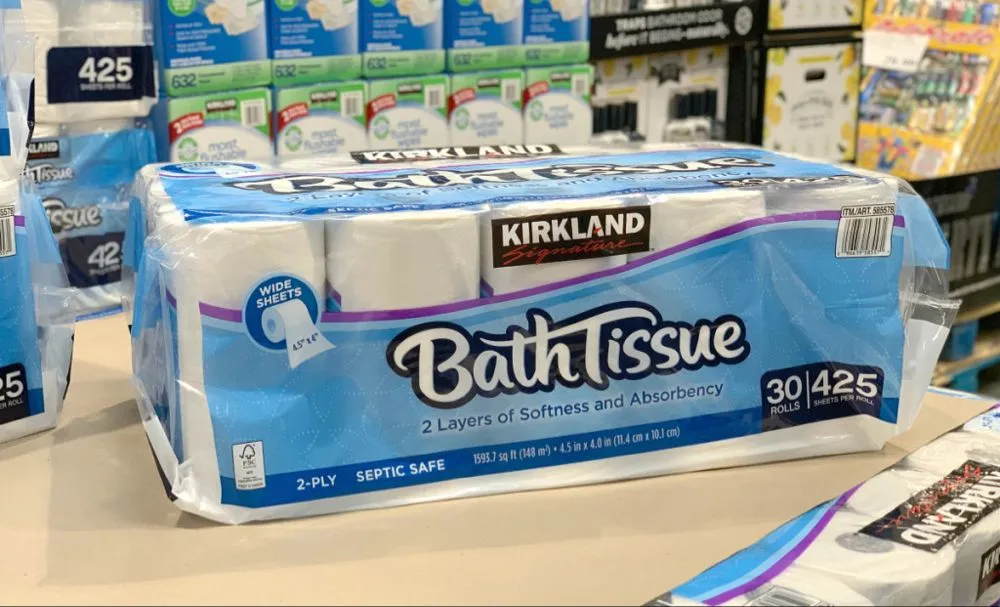
Kirkland's 30-pack of 2-ply, 380-sheet rolls carries a septic-safe label. Recent promo listings showed it at roughly $18 to $21 per pack, though prices vary by warehouse. Two-ply is thicker than the 1-ply budget brands sold for septic homes, and that thickness is the reason I tested it instead of trusting the label.
My Jar Test Review, and Owners' Review of Their Test
Here is the test I run on any roll before it goes near a septic tank. Drop four squares into a quart jar of room-temperature tap water, close the lid, and shake for 10 seconds. Check it out. Shake another 20 seconds and check again. Paper that still holds its shape after 30 seconds is paper I wouldn't flush.
One homeowner on the Plumbing Forums ran a similar test with Kirkland and Scott. Both broke apart, but the Scott sank to the bottom while the Kirkland stayed suspended. That is a useful reminder that a jar is a rough guide, not a lab. On the owner side, people on House Repair Talk report using Kirkland on septic systems for five and even ten-plus years, including one whose tank was pumped with no problems mentioned.
What I could not prove is the long run inside a real tank. A jar shakes the paper far harder than a tank ever will, so I treat the jar test as a pass and not a guarantee.
Where Kirkland Can Still Cause Trouble?
The paper is rarely the real culprit, but people still blame it. In that same Plumbing Forums thread, a homeowner found a floating, bundled mass of paper in his tank and suspected Kirkland. It later turned out the kids had been flushing paper towels, and a cracked, separated drain pipe had caused a clog earlier that year. After he broke up the layer and the tank settled, it looked fine a month later. Paper took the blame for three other problems.
I would still be cautious in three cases:
- A Tank Overdue for Pumping: A full tank clogs on any paper.
- Heavy Use: Big households and bulk-wad habits send more paper at once than a small tank can handle.
- Old or Undersized Tanks: If your tank is old, small, and has clogged before, switch to a 1-ply septic brand until a pro inspects it.
That is not an anti-Kirkland verdict. Thicker paper leaves less margin for error.
What Matters More Than the Brand?
The EPA's septic care guidance says the average household system should be inspected at least every three years, and tanks are typically pumped every three to five years. It also says to flush only human waste and toilet paper. Completely avoid wipes, paper towels, and dental floss, since they're not on the flush list.
A running toilet matters too. The EPA notes that one leaky toilet can add up to 200 gallons of water a day, pushing solids toward the drainfield. Fix that before blaming your toilet paper.
My Verdict
If your tank is healthy and pumped on schedule, Kirkland toilet paper is a reasonable pick, and the owner's history backs that up. If your system is old, small, or has backed up before, run the jar test and consider a 1-ply septic brand until it is inspected.