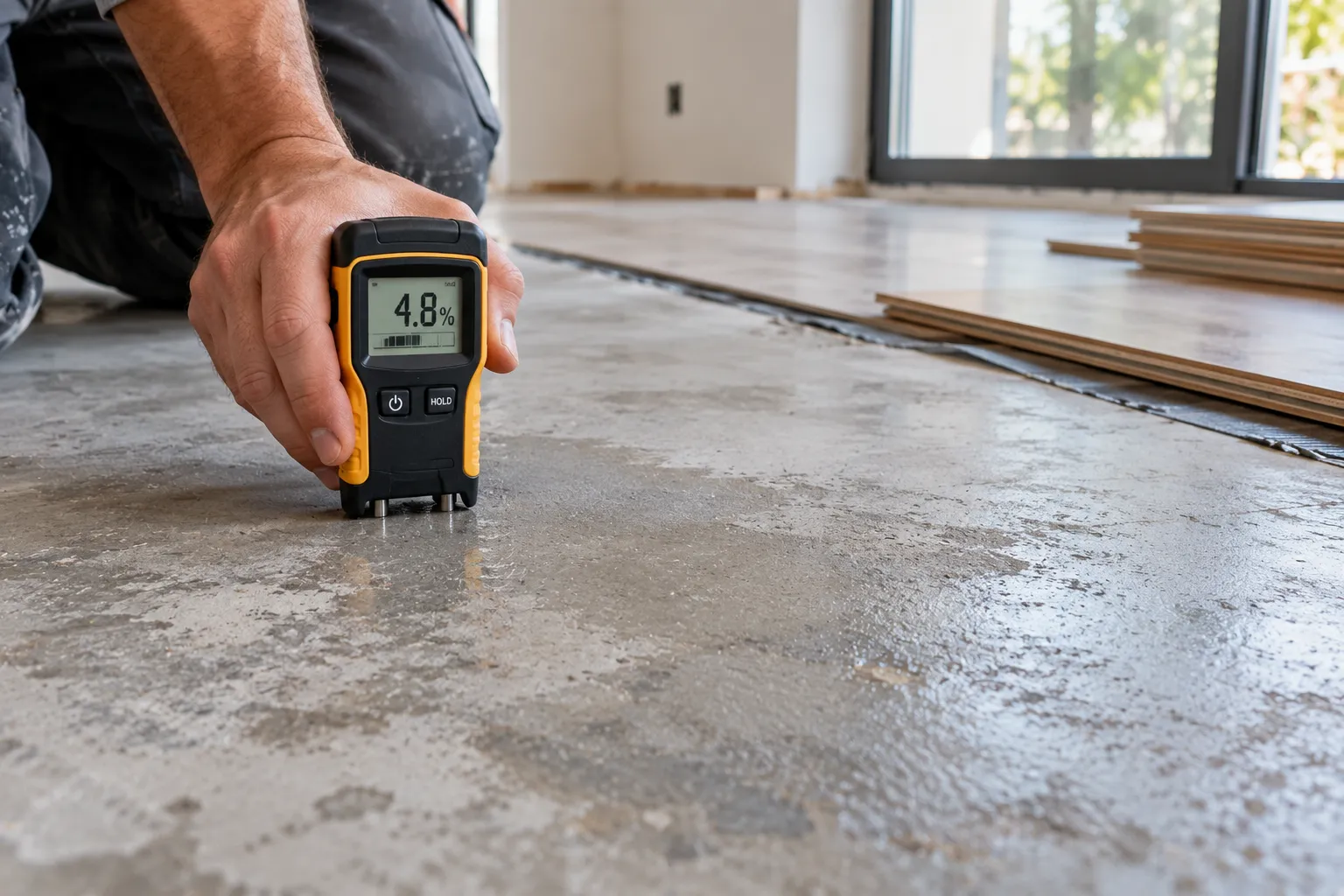
A concrete slab can look completely dry while still holding enough moisture to create problems for a new flooring installation. How can you tell what is happening beneath the surface before the flooring goes down? Moisture trapped inside concrete is not always visible or detectable by touch, yet it can contribute to buckling, adhesive failure, and other costly flooring problems. This is where a concrete moisture meter becomes useful.
By measuring moisture levels within the slab, it gives homeowners and contractors information they cannot get from a visual inspection alone, making it easier to identify potential problems before they become expensive repairs.
Why Concrete Can Look Dry and Still Be a Genuine Problem
It helps to understand the actual industry standard behind this issue. According to ASTM International, excessive moisture in concrete slabs can contribute to flooring failures, including debonding, deterioration, and microbial growth. This is why flooring manufacturers commonly require moisture testing before installation.
That standard matters because it confirms something most homeowners and even some contractors don't fully appreciate, concrete can hold significant internal moisture for weeks or months after the surface appears completely dry, and that trapped moisture doesn't announce itself until it's already damaged the flooring installed on top of it.
What Concrete Hides That Visual Inspection Simply Can't Catch
A handful of specific risks make concrete uniquely deceptive compared to other building materials:
- Internal moisture trapped below a dry surface, since concrete dries from the outside in, leaving a surface that feels dry while the core remains genuinely saturated
- Slow evaporation rates, meaning a slab that looks fine weeks after a flood or spill can still be releasing vapor internally
- Uneven drying across a single slab, particularly in areas with different thickness, ventilation, or sun exposure
- Vapor pressure building beneath an already-installed floor, invisible until it causes adhesive failure or buckling
None of these risks are detectable by sight or touch, which is exactly why an objective reading matters so much more with concrete than with almost any other building material.
Why the Industry Standard Threshold Genuinely Matters
This is really the heart of why a calibrated meter matters so much more than a visual check or a quick touch test. Under the ASTM F2170 standard, industry practice requires a concrete slab's relative humidity to sit at or below 75% before most flooring products can safely be installed. Without a calibrated meter reading that specific number, that threshold is genuinely just a guess.
Using a properly calibrated concrete moisture meter addresses exactly this gap between how a slab looks and what's actually happening inside it. SensoraHome's concrete-specific meters are built to read moisture content or in-situ relative humidity directly from the slab. It gives homeowners and contractors an objective number rather than relying on visual inspection of a dense substrate that can look bone-dry while trapping vapor internally.
Why Using the Wrong Meter Type Makes the Problem Worse
A genuinely common mistake is using a standard wood moisture meter on a concrete slab. It produces a confident-looking number on the display, but that number means essentially nothing for concrete specifically, since wood and concrete respond completely differently to both resistance and electromagnetic sensing methods. A meter genuinely calibrated for concrete accounts for its density and mineral composition in a way a generic meter simply can't.
Pin Versus Pinless: Which Actually Suits a Concrete Slab
The two measurement methods behave differently on concrete specifically, and the right choice depends on the job:
- Pin-type meters push electrical resistance between two probes, excelling at precise spot-checks on specific locations, though they do leave small marks on the surface
- Pinless meters scan electromagnetically, letting a large slab area get checked in minutes without breaking the surface, though signal accuracy can vary on very dense concrete
- ASTM-compliant in-situ probes measure vapor pressure at depth inside the slab itself, the method the F2170 standard specifically requires for flooring installation decisions
- Multi-material meters with concrete-specific calibration modes suit anyone working across several substrates on the same job site
Matching the method to the actual job, a quick screening scan versus a documented, warranty-relevant test, is what determines whether the reading genuinely holds up if a flooring failure is ever disputed later.
What Happens When This Step Gets Skipped
The financial risk here is genuinely significant, not just theoretical. A failed flooring installation over an untested slab typically requires adhesive removal, additional slab drying or sealing, and full flooring replacement, remediation that commonly runs anywhere from $3,000 to $12,000 depending on the area and flooring type involved. Most flooring manufacturers also tie their warranty directly to documented moisture readings, meaning skipping the test, or using an uncalibrated meter, can quietly void that warranty before a single problem even shows up.
A Real Example of What Testing Actually Prevents
A genuinely instructive case involved a new residential build in Miami, where a slab tested above the 75% RH threshold during summer construction. Rather than proceeding with flooring installation and risking the kind of failure described above, the reading itself triggered an 18-day delay while the contractor installed a compatible vapor retarder.
That delay was genuinely inconvenient, but it was considerably less costly than discovering the same moisture problem after flooring had already been installed, adhesive had already failed, and a full tear-out and replacement was the only remaining option.
When Testing Genuinely Matters Most
A concrete moisture meter earns its place in a handful of specific situations: before installing hardwood, vinyl plank, or tile over any slab, after any water intrusion or flooding in a basement or garage, and during new construction, where documenting moisture readings at handoff protects everyone involved, the general contractor, the flooring subcontractor, and the homeowner, with a clear record of the slab's actual condition.
Conclusion
A concrete moisture meter gives homeowners and contractors a clearer picture of what is happening beneath the surface before flooring is installed. Testing first can help identify moisture problems early, reduce the risk of costly failures, and provide greater confidence that the floor is being installed on a suitable slab. With the potential cost of repairs and replacement, taking a few minutes to check moisture levels is a simple step that can protect the entire flooring project.